


National Competence Centre SLING helps users and anyone interested in using High Performance Computing (HPC) to learn, access, use and learn about supercomputing.
Our mission is to promote the use of supercomputing capabilities for scientific and industrial research, academia and public service delivery. We want to raise the level of knowledge in Slovenia and increase awareness of all the benefits of this technology.
We organise free training courses
If you would like to learn how to use a supercomputer or gain specific knowledge, please attend the free workshops or seminars we organise for participants with different levels of knowledge:
- Basic level – no knowledge of using supercomputers is required,
- Advanced level – topics are tailored to different areas of interest with a focus on STEM areas,
- Higher level – participants are expected to have sufficient prior basic knowledge, focus is on increasing competences.
Most of the courses are held in Slovenian, but some are also available in English. Recordings of specific training sessions are available on the Arnes video portal.

Promoting supercomputing in industry
The National Competence Centre promotes, among other things, the use of supercomputers in industry and business. Through a special questionnaire “HPC4SME assesment tool“, we want to help companies to identify the potential for successfully exploiting supercomputing capacities. Based on the answers received, we will provide recommendations and guidelines for the next steps. We help the most promising SMEs to obtain funding in European calls such as FF4EuroHPC and FFplus.
Building a (super)community
The success of the Slovenian National Competence Centre is also reflected in better cooperation and networking between the SLING consortium partners, with other European National Competence Centres and Centres of Excellence. As a result of our close networking, we organised the first ever Slovenian Supercomputing Centres’ Exascale Computing Day or Open Day in 2021, which takes place every year in October. This gave the general public the opportunity to visit the largest Slovenian supercomputers, including EuroHPC Vega. Poleg tega organiziramo jesenske nacionalne HPC-konference Dan slovenskega superračunalniškega omrežja, kjer se osredotočamo na spodbujanje uporabe superračunalnikov, predstavitvi primerov dobrih praks in zgodb o uspehu. Together, we are building a strong community that is reaping the full benefits of supercomputing and creating new opportunities in Slovenia.
The National Competence Centre SLING was established as part of the EuroCC project, National Competence Centres in the Framework of EuroHPC, and continues its activities through the EuroCC 2 and EuroCC 3 projects.
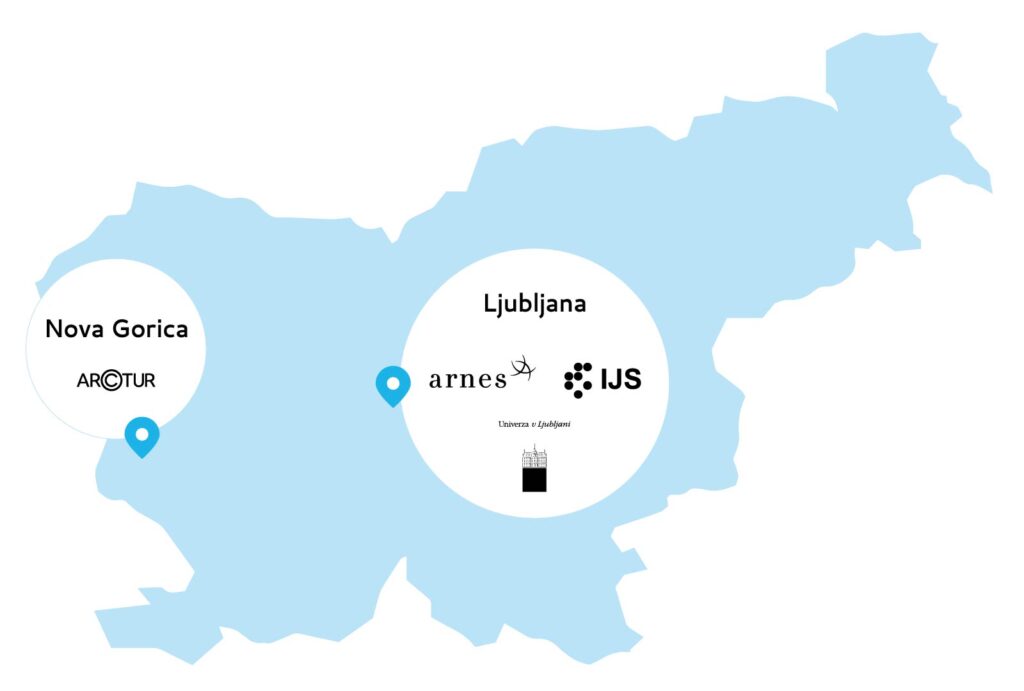
The National Competence Centre SLING currently brings together four active SLING partners: Arctur, ARNES, the Jožef Stefan Institute, and the University of Ljubljana.
Its activities are co-funded by the Ministry of Education, Science and Youth of the Republic of Slovenia.
National Competence Centres Phase 3 (EuroCC 3)
The project “EuroHPC National Competence Centres Phase 3” (EuroCC 3) is the follow-up to the EuroCC Phase 2 project, which ended at the end of March 2026, and is implemented under the Digital Europe programme of the European Union. It continues to establish a network of European National Centres of Competence in the most efficient way, while addressing the differences in the maturity of the deployment of Europe’s High Performance Computing (HPC) capabilities. The project focuses on monitoring the progress of the National Competence Centres and supporting their development and the establishment of operational frameworks, accessing and making the best use of the experience and expertise currently available at national and European level.
To this end, EuroCC 3 is working closely with the CASTIEL 3 project, which is tailored to the needs of national competence centres and also includes AI Factories. Together, they aim to foster cooperation, exchange best practices and knowledge at European level and accelerate the improvement of national and thus European supercomputing capabilities and their use.
National Competence Centres play a key role in coordinating activities related to the use of supercomputers at national level. We are the main point of contact for users from the scientific, academic, and industrial fields, for experts in the field of supercomputing, and for the general public. The Competence Centres are involved in a wide range of activities, including training and skills development, providing services to industry, academia and public administration, collaboration with other relevant stakeholders in supercomputing, management of the list of services and competences, public information and project management.
The EuroCC 3 project, which runs from 1. 4. 2026 until 31. 3. 2029, with more than 40 members and associate members from 36 countries, coordinated by the University of Stuttgart (HLRS).
Read NCCs success stories to learn how high-performance computing (HPC) is being successfully applied across research and industry:
HPC in Europe Portal
The HPC in Europe Portal is a central platform designed to unify Europe’s high-performance computing (HPC) ecosystem by bringing together resources, services, training opportunities, and expertise in one accessible hub. Developed under the CASTIEL 2 project in collaboration with EuroCC 2 and HPC SPECTRA, the portal supports researchers, SMEs, industry professionals, policymakers, and public institutions.
It integrates content from National Competence Centres (NCCs) and Centres of Excellence (CoEs), a few European projects offering access to events, training materials, success stories, podcasts, videos, competence maps, and HPC services.
By consolidating previously scattered information, the portal promotes collaboration, knowledge sharing, innovation, and easier access to Europe’s growing supercomputing ecosystem.